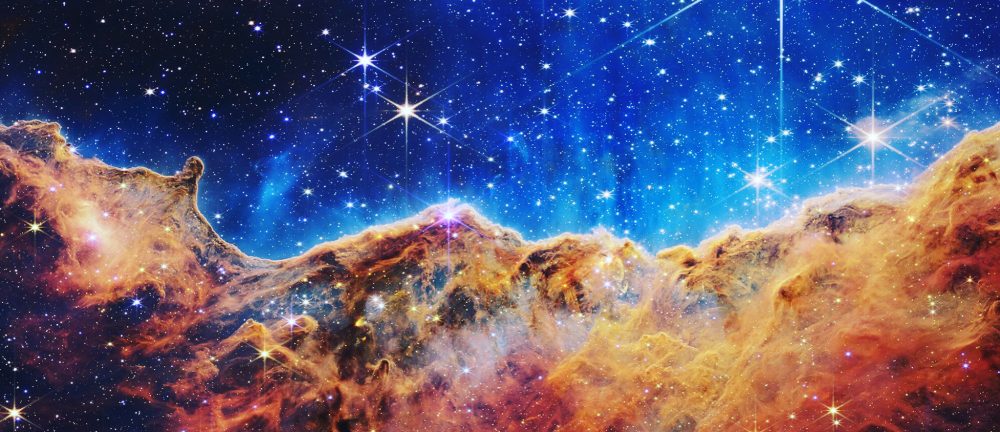
The Milky Way Galaxy

Our Sun (a star) and all the planets around it are part of a galaxy known as the Milky Way Galaxy. A galaxy is a large group of stars, gas, and dust bound together by gravity. They come in a variety of shapes and sizes. The Milky Way is a large barred spiral galaxy. All the stars we see in the night sky are in our own Milky Way Galaxy. Our galaxy is called the Milky Way because it appears as a milky band of light in the sky when you see it in a really dark area.

It is very difficult to count the number of stars in the Milky Way from our position inside the galaxy. Our best estimates tell us that the Milky Way is made up of approximately 100 billion stars. These stars form a large disk whose diameter is about 100,000 light years. (one light-year is the distance traveled by light in one year: 5.88 trillion miles and is used to express astronomical distances). Our solar system is about 25,000 light-years away from the center of our galaxy. We live in the suburbs of our galaxy. Just as the Earth goes around the Sun, the Sun goes around the center of the Milky Way. It takes 250 million years for our Sun and the solar system to go all the way around the center of the Milky Way.

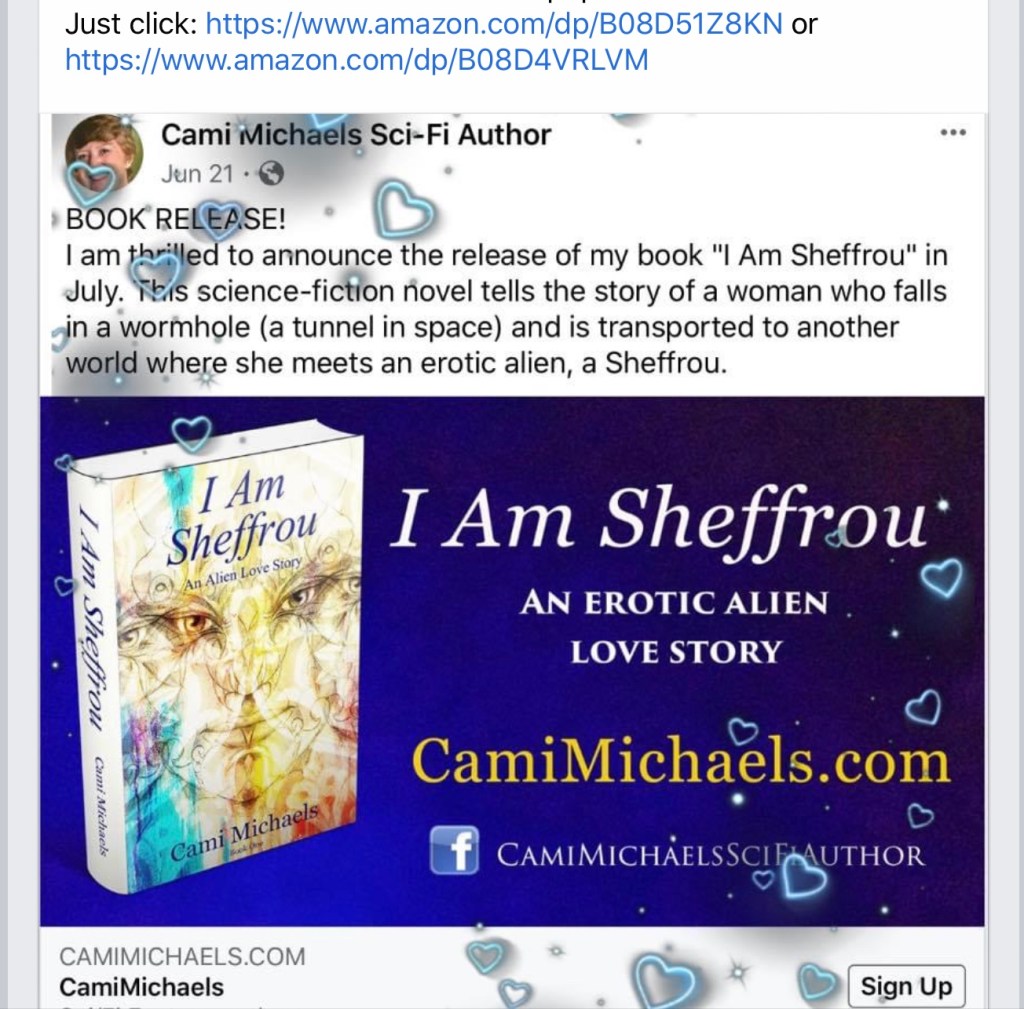
Astronomers estimate that one in six stars has an Earth-like planet so it is conceivable to imagine that life has evolved on some of these planets and a few may even have advanced life forms. In a previous blog I talked about wormholes and how someone could travel to another part of the galaxy with the help of a wormhole. It is theoretically possible therefore to come in contact with an intelligent life form on another world. This is the premise on which I have based my science-fiction novel “I Am Sheffrou”. The storyline is: A woman falls in a wormhole and travels to another world where she meets an erotic alien. Now available on Amazon.

e-book:  https://www.amazon.com/dp/B08D51Z8KN
Science Fiction or Fantasy?

What is the difference? Excerpts from David D. Levine

“People have been arguing about where the line between fantasy and science fiction falls as long as the two labels have existed, and I’m not pretending to have the single answer that will work for everyone….

Science fiction, in my opinion, is based on an Enlightenment worldview: the universe is logical, predictable and understandable, governed by rules that are impersonal and have no moral dimension…. Even if the rules of the universe are not currently completely understood, the expectation is that with further observation and experimentation, and perhaps better math, they can eventually be worked out.

Fantasy, on the other hand, is based on a pre-Enlightenment worldview: the universe has a moral compass, and is governed by rules that, though they may be understandable, are not necessarily always consistent, logical, or predictable in their application….The fantasy universe is luminous, mysterious, and full of wonder. Most important, the fantasy universe is personal. It is aware of, and cares about, humans and human concerns, and outcomes of actions are at least partly determined by the actor’s attitudes, personalities, and heritage….

The science fiction world is a collection of physical processes that have no consciousness or personality and cannot be influenced by human moral codes….But in a fantasy story, the characters can expect that immoral or ungodly action will eventually be punished by a just universe….

The fantasy universe is full of swords that may be drawn only by the pure of heart, unicorns that can be ridden only by virgins, and doors that open only for the rightful king…. magic systems in which the magic behaves like a technology—predictable and repeatable—are sometimes found in fiction, though many readers feel they lack a sense of “wonder”….

Speaking of “sense of wonder” … I feel that both SF and fantasy are capable of delivering this ineffable feeling…. But, to me, the assertion that either genre is morally superior to the other is a fundamentally anti-Enlightenment stance, requiring an imposition of moral order upon a literary universe that ought to be governed by humanistic rational principles. And isn’t a humanistic, rational worldview what science fiction is all about?”

There you have it. Science fiction and fantasy are two genres that provide a sense of wonder, are often intertwined, and neither one is superior to the other. Which one do you prefer?  

Wormholes

What are they and why are they important in my novel I Am Sheffrou? First, let’s look at the wormhole theory.

Wormholes explained – Breaking spacetime

If you saw a wormhole in reality, it would appear round, spherical, a bit like a black hole. Light from the other side passes through and gives you a window to a faraway place. Once crossed, the other side comes fully into view with your old home now receding into that shimmering spherical window.

But are wormholes real, or are they just magic disguised as physics and math? If they are real, how do they work and where can we find them?

I they are real, how do they work and where can we kind them?

For most of human history, we thought space was pretty simple, a big flat stage where the events of the universe unfold. Even if you take down the set of planets and stars, there’s still something left. That empty stage is space and it exists unchanging and eternal.

Einstein’s theory of relativity changed that. It says that space and time make up that stage together, and they aren’t the same everywhere. The thing on the stage can affect the stage itself, stretching and warping it. If the old stage was like unmoving hardwood, Einstein’s stage is more like a waterbed.

Our universe is like a big flat sheet, bent in just the right way, wormholes could connect two very, very distant spots with a short bridge that you could cross almost instantaneously. Enabling you to travel the universe even faster than the speed of light.

So where can we find a wormhole?

Presently, only on paper! General relativity says they might be possible, but that doesn’t mean they have to exist. General relativity is a mathematical theory. It’s a set of equations that have many possible answers, but not all math describes reality. But they are theoretically possible and there are different kinds. Text from Academic Guide. For more info please refer to Academic Guide Wormholes explained.

Isn’t this fascinating! Wormholes may exist! 

At least the late great physicist Stephen Hawking thought so. So this means you can connect two points in space-time or, if you will, two different universes by traveling through a wormhole! This is a very important theory because that’s how Tamara, in I Am Sheffrou travels to a different world.


Imagination

Hello fellow writers,

J. K. Rowling, famous author of the well-known Harry Potter series, said in her Harvard School commencement speech in 2008, “Imagination is not only the uniquely human capacity to envision that which is not and therefore the fount of all invention and innovation…but also the capacity to empathize with humans whose experiences we have never shared.”

What an enlightened statement! Then and now, imagination remains a crucial part of our lives. Whether we use it as a tool in our science-fiction and fantasy writing, or in our everyday lives, the world as we know it would not be the same and without imagination there would not be change and improvement in our lives and the lives of others.